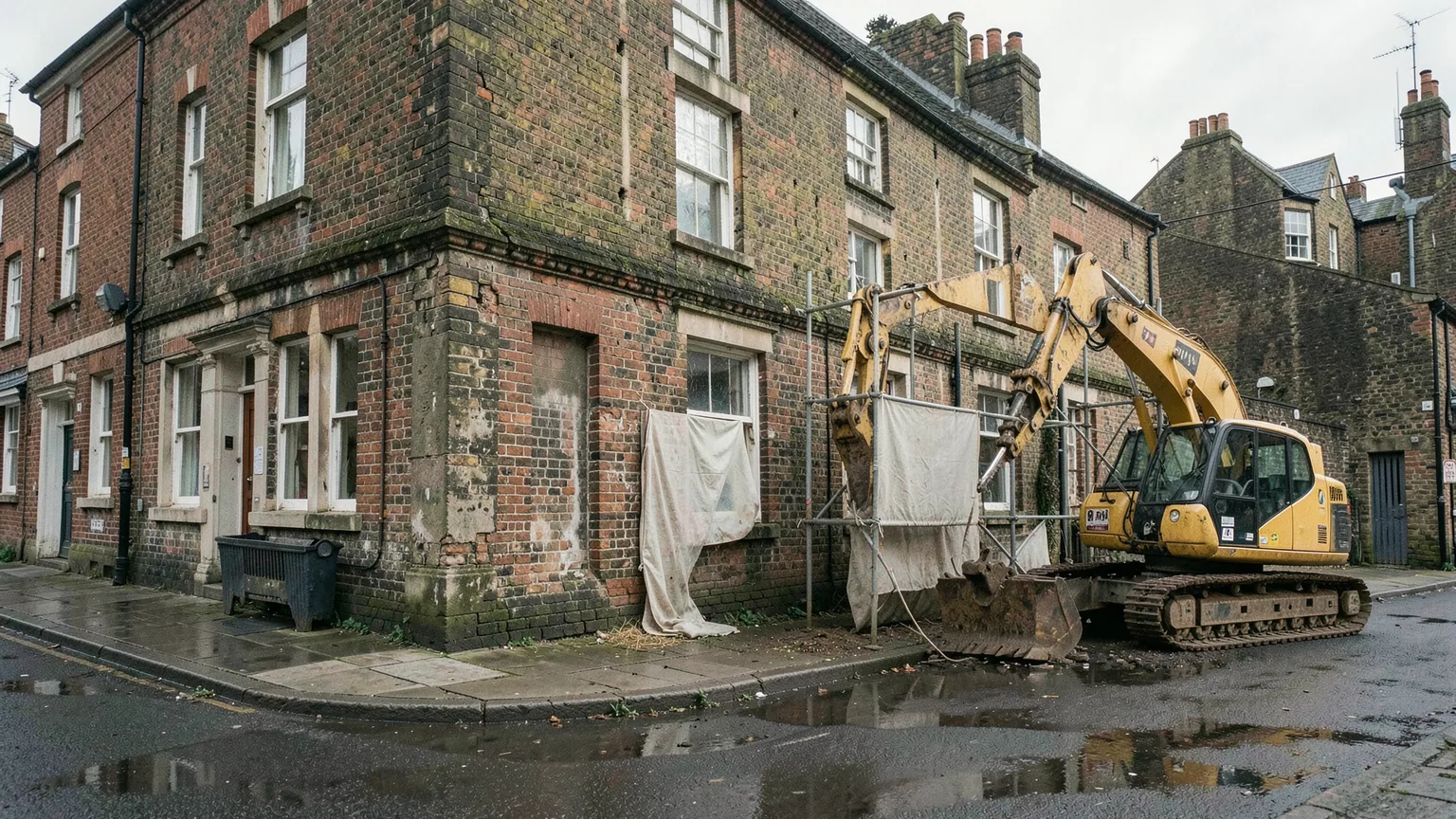
Dust, noise and working hours for Bristol demolition
Dust and noise from a demolition site in Bristol are controlled by three separate sets of rules: a council power to set conditions on the works, a consent route the contractor can use before any machine arrives, and the general statutory nuisance regime that applies to premises. Each has a different trigger and a different remedy. Working hours sit inside the first two, which means they are usually fixed by a document the owner can ask to see rather than by a rule of thumb.
The two Control of Pollution Act routes
Section 60 of the Control of Pollution Act 1974 covers demolition work alongside construction, road works and engineering. Where a council considers that such works are being carried out, or are going to be, it may serve a notice that can specify the plant or machinery to be used or avoided, the hours during which the work may take place and the level of noise that may be emitted. The council has to have regard to what is practicable to keep noise down, and before it prescribes a particular method it must consider whether other methods would be substantially as effective and more acceptable to the people affected.
Section 61 of the same Act provides the route a contractor can take in advance. A person who intends to carry out such works may apply to the council for prior consent under section 61. The application must set out the works and the method by which they are to be carried out, together with the steps proposed to minimise noise. Where building regulation approval is needed, the application has to be made at the same time as, or after, the request for that approval. If the council is satisfied that the works, carried out as described, would not justify a section 60 notice, it must give its consent. It can attach conditions, limit the consent to changed circumstances and limit how long it lasts. The council must tell the applicant its decision within 28 days of receiving the application.
The conditions matter as much as the consent itself. Anyone who knowingly carries out works, or allows them to be carried out, in breach of a condition commits an offence under the same Part of the Act. For an owner, the practical test is simple: ask the contractor for the consent or notice in writing, and check that the hours and plant listed in it match the programme being quoted.
Statutory nuisance and what it covers
The second set of rules is the statutory nuisance regime in Part III of the Environmental Protection Act 1990, where section 79 names the conditions the council must act on. Two of those conditions can arise from demolition. The first is noise emitted from premises so as to be prejudicial to health or a nuisance. The second is dust, steam, smell or other effluvia arising on industrial, trade or business premises and being prejudicial to health or a nuisance.
The dust limb is worded for industrial, trade or business premises, so it does not map neatly onto a house being taken down for a new build. Whether a particular site falls within it is a question for the council's environmental health team, which decides which provision applies to the complaint. A neighbour who is troubled by dust from a demolition should therefore report it promptly and keep a dated record of what was seen, rather than assume that a particular section already covers the problem.
Statutory nuisance is a remedy after the event, whereas section 60 and section 61 operate before and during the work. For that reason the consent route is the one to check first when planning a Bristol job, especially where houses share walls with the site and a single complaint can halt a programme.
Dust control and worker health
Dust on a demolition site is a worker-health issue as well as a neighbour issue. Cutting, drilling, grinding and breaking masonry or concrete can release respirable crystalline silica, the fine dust that is too small to see under normal lighting. The HSE's silica dust guidance explains that heavy and prolonged exposure can cause lung cancer and other serious respiratory diseases, and that silica is the biggest risk to construction workers after asbestos.
That is why dust control is usually written into the contractor's method statement, not left to the operatives on the day. The statement should name the operations that produce dust, the controls used for each one and who checks that they are working. HSE's silica guidance links onward to its advice on controlling exposure, and a contractor should be able to explain which of those measures it uses. An owner does not need to judge the engineering, but can reasonably ask how the contractor intends to keep dust from reaching the pavement, the neighbouring gardens and the street.
If the building holds asbestos, the dust question changes character entirely and falls under the licensing and survey rules explained in the licensed asbestos firm guide.
Noise on site and the choice of plant
Noise has two audiences: the workers who operate the plant and the neighbours who hear it. HSE's guidance on noise in construction records that many construction tasks, tools and equipment produce high noise levels and that frequent exposure causes hearing problems. Employers have to prevent or reduce those risks under the Control of Noise at Work Regulations 2005, which is a workplace duty separate from the council's powers over neighbours.
For neighbours, the most useful lever is the choice of plant. Because section 60 allows a council to specify which plant or machinery may or may not be used, the method decided at the outset carries real weight. A large hydraulic breaker on a rear extension, for example, will be heard in a way that a careful, slower method may not be. The trade-offs between mechanical and manual methods are covered in the guide on choosing a Bristol demolition method.
Working hours in Bristol
There is no single set of working hours that applies to every demolition in Bristol. The hours a site may work are normally set by the council's notice or consent conditions, or by a planning condition where one exists. Because they vary from job to job, an owner should ask the contractor for the current position in writing before fixing a start date, and should check that the hours in the programme match the document.
Demolition in districts such as Bedminster, St George and Easton often takes place close to neighbouring homes, sometimes beside a shared wall. In that setting, the hours and noise limits matter to the people next door as much as to the contractor. Telling neighbours early, with the dates of the noisiest stages, reduces the chance of a complaint reaching the council. The practical steps are set out in the guide on telling neighbours about demolition in Bristol, and the local demolition services in Bristol cover the kind of site where these issues arise most often.
What to ask a contractor before work starts
Before accepting a quote, an owner can ask a short list of questions that expose whether dust and noise have been planned for rather than improvised:
- Is there a section 60 notice or a section 61 consent in place, and can the conditions be seen in writing?
- Which plant will be used for each stage, and which noisy operations are planned for which days?
- What dust suppression is in the method statement, and who inspects it during the work?
- Who answers a complaint from a neighbour, and how quickly will they respond?
- If the site is near a listed or older structure, how will vibration be monitored?
A contractor that answers these questions with a specific plan is easier to compare than one that offers a general assurance. Where a quote does not mention noise, dust or hours at all, that is a reason to ask again before comparing prices. Clearing the site after the main work, which is often arranged through site clean-up services, should be covered by the same plan so that dust from loading does not undo the suppression used during demolition.
Bristol owners who want the price of this work compared on a like-for-like basis can request quotes from several providers, sending each one the same site details, the same list of questions and the same expectations about hours. The earlier the noise and dust plan is in writing, the fewer changes the programme is likely to need once the work starts, and the more predictable the neighbours' experience will be.
Sources and further reading
- Control of Pollution Act 1974, section 60: control of noise on construction sites (legislation.gov.uk)
- Control of Pollution Act 1974, section 61: prior consent for work on construction sites (legislation.gov.uk)
- Environmental Protection Act 1990, section 79: statutory nuisances (legislation.gov.uk)
- Silica dust in construction: health risks (HSE)
- Construction physical ill health risks: noise (HSE)