Bats and nesting birds before demolition in Bristol
Before a Bristol building is demolished, the owner or contractor has to check whether bats or nesting birds use it, because both are protected by law even where the building itself is not listed. Bats are protected under the Conservation of Habitats and Species Regulations 2017, and wild birds and their active nests under the Wildlife and Countryside Act 1981. A survey that is done at the wrong time of year, or not done at all, can stop a demolition after it has been priced and booked, so the check belongs at the start of the programme, not on the morning the machines arrive.
Why bats and birds can stop a demolition
The two regimes protect different things. Bats are a European protected species, and the offences are framed around the animals and their homes. Under regulation 43 of the Conservation of Habitats and Species Regulations 2017, it is an offence deliberately to capture, injure, kill or disturb a protected animal or to take or destroy its eggs, and it is also an offence to damage or destroy a breeding site or resting place. The last of those offences does not require the damage to be deliberate, and Natural England's advice makes clear that a roost stays protected even when no bats are present. A conviction can bring up to six months' imprisonment, an unlimited fine or both. The disturbance limb is wider than it sounds, because it covers any disturbance likely to impair an animal's ability to survive, breed or rear its young.
The bird rules work from a different starting point. Section 1 of the Wildlife and Countryside Act 1981 makes it a crime to act intentionally against a wild bird itself, or against its nest while that nest is occupied or under construction. Destroying an egg falls under the same provision. Because the test is tied to occupation, a nest tucked into a roof space or behind eaves stays protected for as long as the birds are using it, whatever stage the demolition has reached.
For a demolition contractor these rules have a practical consequence. Stripping a roof, pulling down a gable or opening a loft can destroy a roost or a nest in a few minutes. Destroying a bat roost is an offence whether or not it was intended, and regulation 43 tells the court to consider, when sentencing, whether the damage could reasonably have been avoided, so a contractor that has been told a building may be used by bats and then strips it without a survey or a plan is in a very weak position.
How to tell whether a building needs a survey
Natural England's guidance on bat surveys and mitigation for development projects sets out what a survey has to achieve. Surveys must be carried out in the most recent, appropriate season, identify the bat species and the size of the population, and identify the type of roost and its importance, including the access points bats use to enter it. They should also identify the flight routes and foraging areas close to the proposed development.
The same question arises in the wider planning guidance. GOV.UK's note on reviewing planning applications for protected species lists the habitats and buildings where protected species are likely to be found. Buildings with features suitable for bats are one of these categories, and the guidance points to wild birds and other species as well. A traditional timber-framed building, such as a barn, is listed as a likely home for bats and barn owls.
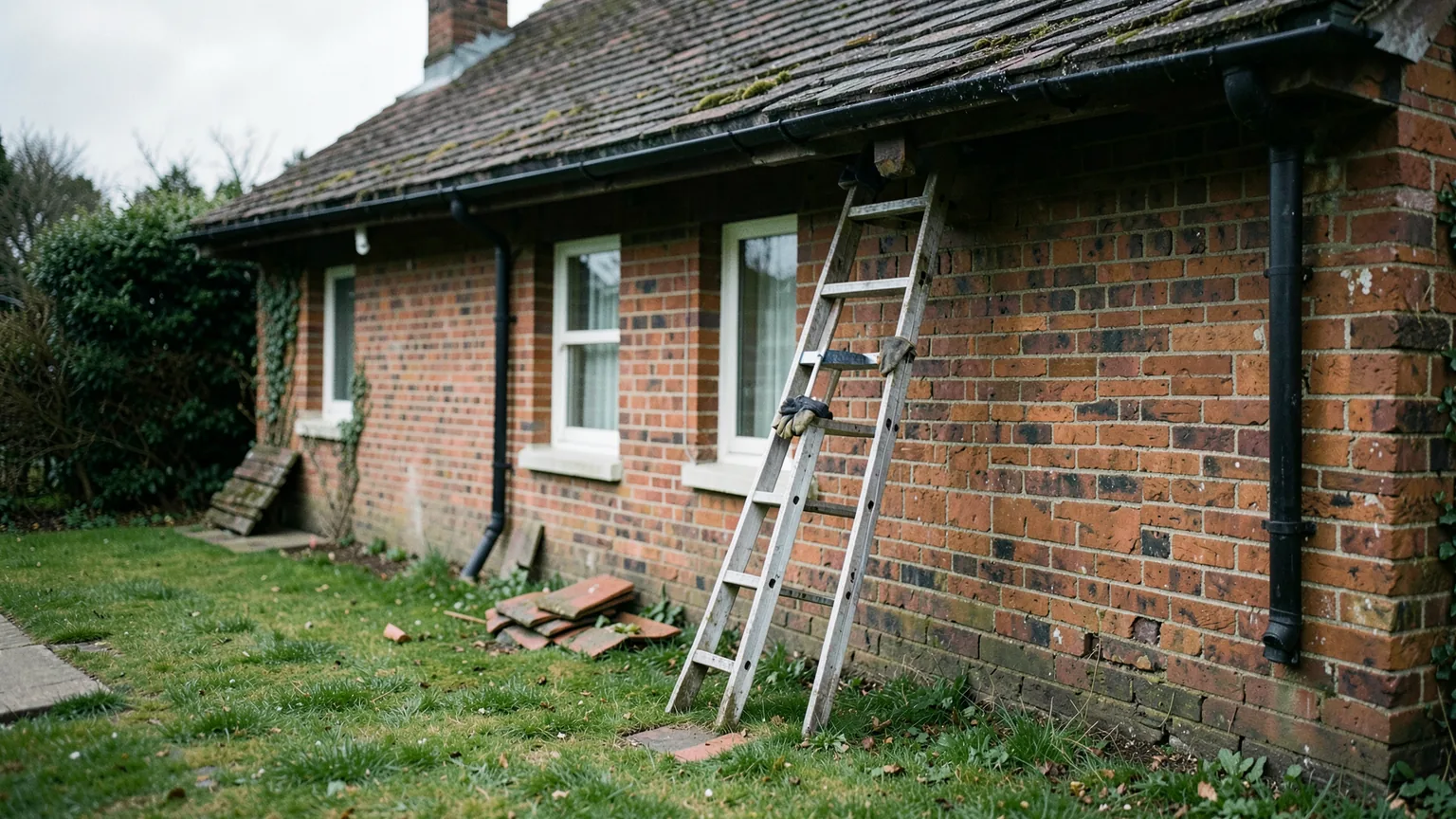
For a typical Bristol house or garage, the features worth checking are the ones an owner can see from the outside and the ones an inspector looks for inside: gaps under roof tiles, lifted ridge tiles, gaps behind fascias and soffits, weatherboarding, and the loft space. Older houses tend to have more of these features than modern builds, but the presence of a feature is a reason to survey, not proof that an animal is there, and an absence of features is not proof either. Only an inspection can settle the question for a particular building.
Timing the survey and the work
The timing of the survey is part of what Natural England's standing advice expects, not a scheduling detail. The guidance says surveys must be carried out in the most recent, appropriate season, which means a survey done months before the work may need to be repeated. A survey that found no bats in an earlier season should not be assumed to remain valid for a later programme, and a contractor that holds an old report may have to commission a fresh one before starting.
Nesting birds bring a different timing problem. Because the offence turns on whether a nest is in use or being built, a nest found on the morning of demolition has to be left alone, and the work around it has to stop until the birds have finished. An owner cannot solve this by asking the contractor to start early in the day or to work quickly.
Where a survey finds bats, the work normally cannot go ahead on the original programme unless it is covered by a licence from Natural England, or by a method that the survey findings and the licensing rules allow. The licence process takes time and carries conditions about how the work is done, so an owner should expect the programme to move once bats are confirmed. Where birds are nesting, the simplest route is usually to delay the affected stage until the nest is no longer in use.
The content of a survey report matters as much as the fact that one exists. A report that only says bats were not seen is less useful than one that records the inspection method, the features examined, the season and the conclusions drawn about roosts and access points. An owner or contractor reading the report should be able to see which parts of the building were inspected, whether the inspection was internal or external, and what the surveyor recommends for timing. A short report that leaves these points open gives the contractor little to plan around. Bristol City Council, as local planning authority, will also expect ecology information to be clear where a demolition forms part of a wider planning application.
What an owner should ask for
Before accepting a quote for a demolition in Bristol, an owner can ask five direct questions about wildlife:
- Has the building been surveyed for bats and nesting birds, and by whom?
- When was the survey carried out, and is it still within the period the contractor relies on?
- If bats or nests were found, what does the plan say about timing, licences and stopping work?
- Who inspects the building on the day before stripping starts?
- Who pays for any re-survey or delay, and how is it reflected in the price?
The answers tell an owner whether wildlife has been treated as a programme risk or as an afterthought. A quote that lists a survey as a separate item, with a date and a named ecologist, is easier to compare than one that says nothing about the subject. The same logic applies to the asbestos survey, which is usually commissioned alongside the wildlife check; the sequence is set out in the guide on asbestos surveys before demolition in Bristol.
Garages, sheds and other small buildings
Protected species are not confined to houses. Garages, sheds and outbuildings with pitched roofs, gaps under eaves or old timber can be used by bats and nesting birds, and a small outbuilding can be the easiest part of a job to overlook. The work is often simpler than a house, but the legal test is the same, and a contractor that treats a garage as a quick strip should still check it first.
The practical question for a garage is whether the roof or the eaves can be opened without disturbing a roost or a nest. Those details are worth raising with the contractor when a garage or shed is part of a larger project. Where the job is limited to a single outbuilding, the garage demolition service and the wider residential demolition service cover the same survey questions, and the full project can be quoted through the comparison form with the survey information attached.
Protected species are one of the few parts of a demolition programme that no contractor can price in advance without information. An honest quote will say so, and will show how the work will change if a survey finds something. Owners who get that information early avoid the most expensive kind of delay, which is a stopped site with a fixed deadline behind it.
Sources and further reading
- The Conservation of Habitats and Species Regulations 2017, regulation 43 (legislation.gov.uk)
- Wildlife and Countryside Act 1981, section 1: protection of wild birds, their nests and eggs (legislation.gov.uk)
- Bats: advice for making planning decisions (Natural England) (GOV.UK)
- Protected species and development: advice for local planning authorities (GOV.UK)