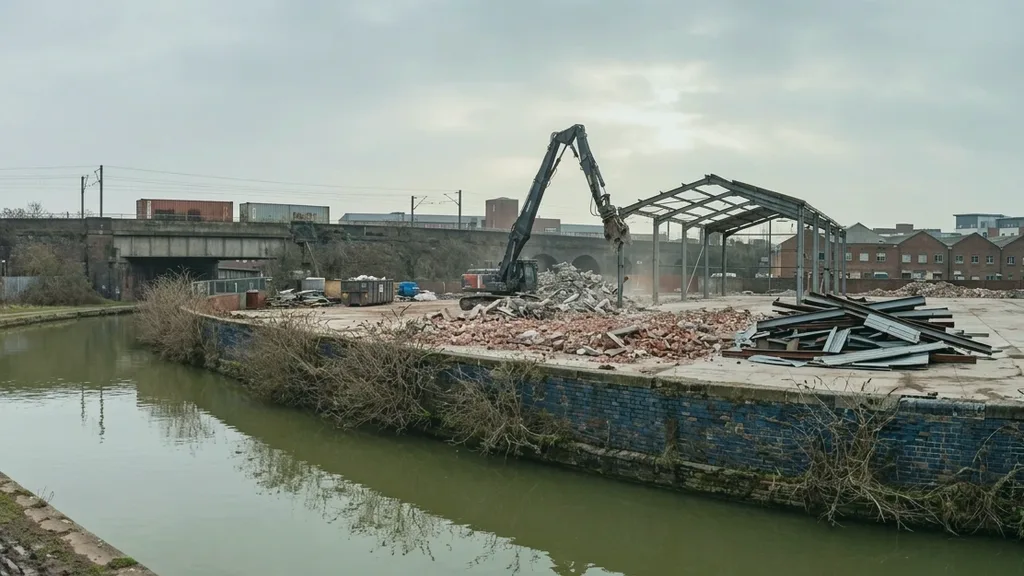
Half-cleared light-industrial plot on a canal bend

BristolDemolition in St Philips / Temple Quarter

Demolition Services in St Philips / Temple Quarter, Bristol

Describe the work once and compare local demolition services providers covering St Philips / Temple Quarter.
Compare Quotes

Demolition Services in Your Area

Describe your location, demolition scope and access constraints to request local estimates.

Step 1 of 7: What type of demolition do you need?

What type of demolition do you need?

What type of demolition do you need?
  • Serving St Philips Marsh, Silverthorne Lane, Feeder Canal
  • Compare several quotes from providers covering St Philips / Temple Quarter
  • Free to use, and you choose which quote to accept

demolition services in St Philips / Temple Quarter

Demolition Services in St Philips / Temple Quarter: a local guide

St Philips Marsh sits in a bend of the River Avon just east of Temple Meads, and its building stock still carries the marks of its working past. Rows of narrow Victorian terraces, built for workers at the tanneries, glassworks and engineering sheds that once lined the Feeder Canal, stand alongside single-storey light-industrial units thrown up in the 1950s and 60s. Corrugated asbestos-cement roofing covers many of these sheds, and few of the plots inside BS2 carry any conservation-area designation, which leaves demolition and site clearance governed chiefly by Building Act notification rather than heritage consent. The district's mix of domestic terraces and disused industrial land means every project here starts from a different structural baseline.

The local context in St Philips / Temple Quarter

Taking down a building in St Philips can involve more than the structure itself. Former tannery and engineering plots may need ground information before excavation, and terraced rows can have shared walls that require careful sequencing and professional advice. Light-industrial sheds from the mid-twentieth century may have asbestos-cement roof sheets or wall cladding, so a competent survey and risk assessment should inform any removal method before structural work begins.

Much of St Philips Marsh now falls inside the Temple Quarter regeneration masterplan, which has accelerated the pace at which ageing light-industrial stock is being cleared to make way for new development. That pressure has brought forward demolition work on buildings that would otherwise have stood for years, and it means site clearance increasingly has to fit around active construction traffic on neighbouring plots, temporary haul roads and phased handover dates set by the wider scheme. Silverthorne Lane and the streets running off Albert Road see the heaviest plant movement, while properties closer to the Feeder Canal face additional access restrictions tied to the waterway.

Homes and buildings in St Philips / Temple Quarter

A St Philips brief should begin with the structural and environmental information rather than a quote pulled from a floor plan. Where ground contamination is suspected, ask how soil sampling would be arranged before excavation, and where a shared party wall is involved, ask whether a surveyor and a schedule of condition are appropriate before mechanical work starts. The client should check with Bristol City Council whether a demolition notice or other local consent is required, and the project team should set out dust control, propping and utility isolation in the construction-phase arrangements. Suspect roofing should be identified by a competent survey before any structural work proceeds.

Questions to ask about work in St Philips / Temple Quarter

A useful quote itemises the survey, the notice and licence work, the demolition method and the disposal route for whatever comes off the plot, so there is nothing left to discover once work is underway. Reclaimed brick and steel from the district's older sheds is sorted for resale where condition allows, and crushed concrete is graded for reuse as sub-base rather than trucked out as waste. Because contractors work across the whole Temple Quarter footprint, the contractor should hold current waste-carrier registration and consignment paperwork for hazardous material leaving St Philips, which keeps a project moving instead of stalling on compliance. Retained boundaries also need a recorded handover.

St Philips / Temple Quarter at a glance

What providers need to know about St Philips / Temple Quarter

The details a provider asks about before quoting for work in St Philips / Temple Quarter.
01Act 01
  1. Inside St Philips / Temple Quarter

    St Philips Marsh, Silverthorne Lane, Feeder Canal, Temple Meads.
  2. Next to St Philips / Temple Quarter

    Redfield, Barton Hill, Totterdown.
  3. St Philips / Temple Quarter housing stock

    BS2 postcode: former industrial land and Victorian workers' terraces around St Philips Marsh sit largely outside any conservation-area designation, with much of the district earmarked for the...
02Act 02
  1. What goes wrong in St Philips / Temple Quarter

    Shared party walls between Victorian terraced rows, possible asbestos-cement roofing on light-industrial sheds, contaminated land on former tannery and engineering plots, and the need to check...
  2. Getting to a St Philips / Temple Quarter address

    Narrow lane access off Albert Road and Silverthorne Lane, active rail lines bordering Temple Meads restricting plant movement hours, and canal-side load limits for waste barges.

Gather the details needed to compare written quotes

Measurements, photographs, inclusions, credentials, and handover expectations give each provider the same evidence base.

Before You Compare

  • Define the scope

    Mention access limits, occupied spaces, deadlines, and the property and access conditions in St Philips / Temple Quarter early so providers do not price around different assumptions.
  • Spot gaps between quotes

    A lower total for the work may cover less work. Ask providers to clarify exclusions, allowances, timing, and payment terms where their assumptions differ.
  • Verify before you choose

    Ask for the credentials and insurance relevant to the work, plus any warranty, inspection, testing, or handover records offered.
One enquiry, several written quotes

Start your demolition services enquiry in St Philips / Temple Quarter

Give providers the context they need for St Philips / Temple Quarter, then compare scope, timing and price.
Compare Quotes
Illustrative photography

Use visual references to describe the job

These illustrative photographs can help identify visible elements for a brief, but a provider must assess the actual site and scope.

Demolition Services in St Philips / Temple Quarter: common questions

What people in St Philips / Temple Quarter ask before comparing quotes.

Local coverage

Compare the local details that can shape a job

These guides provide local planning context. Confirm access and site conditions for your own property when requesting quotes.
Totterdown
Residential demolition guidance for Totterdown’s steep terraces and constrained rear plots.Services in Totterdown
Avonmouth
Dockside warehouse decommissioning, slab removal, and site clearance in BS11.Services in Avonmouth
Fishponds / Staple Hill
Domestic garage teardown, outbuilding clearance, and rear extension demo in BS16.Services in Fishponds / Staple Hill
Kingswood
Terraced house party-wall teardowns, workshop clearance, and demo across BS15.Services in Kingswood

Get demolition services quotes for St Philips / Temple Quarter

Use the form above to tell us what you need in St Philips / Temple Quarter — we pass it to providers so you can compare several quotes, with no obligation.
Step 1 of 8: What type of demolition do you need?

What type of demolition do you need?

What type of demolition do you need?