Mechanical or manual: choosing a Bristol demolition method
How a building is taken down matters as much as the fact that it comes down. The method determines how far the debris travels, how long neighbours must tolerate noise and dust, which parts of the site must be kept clear and how much labour is needed by hand. In Bristol, where many buildings stand close to others, the choice is rarely about machines against people. It is about which combination of plant and manual work suits the structure, the neighbours and the programme. This guide describes the common approaches and the trade-offs that come with each.
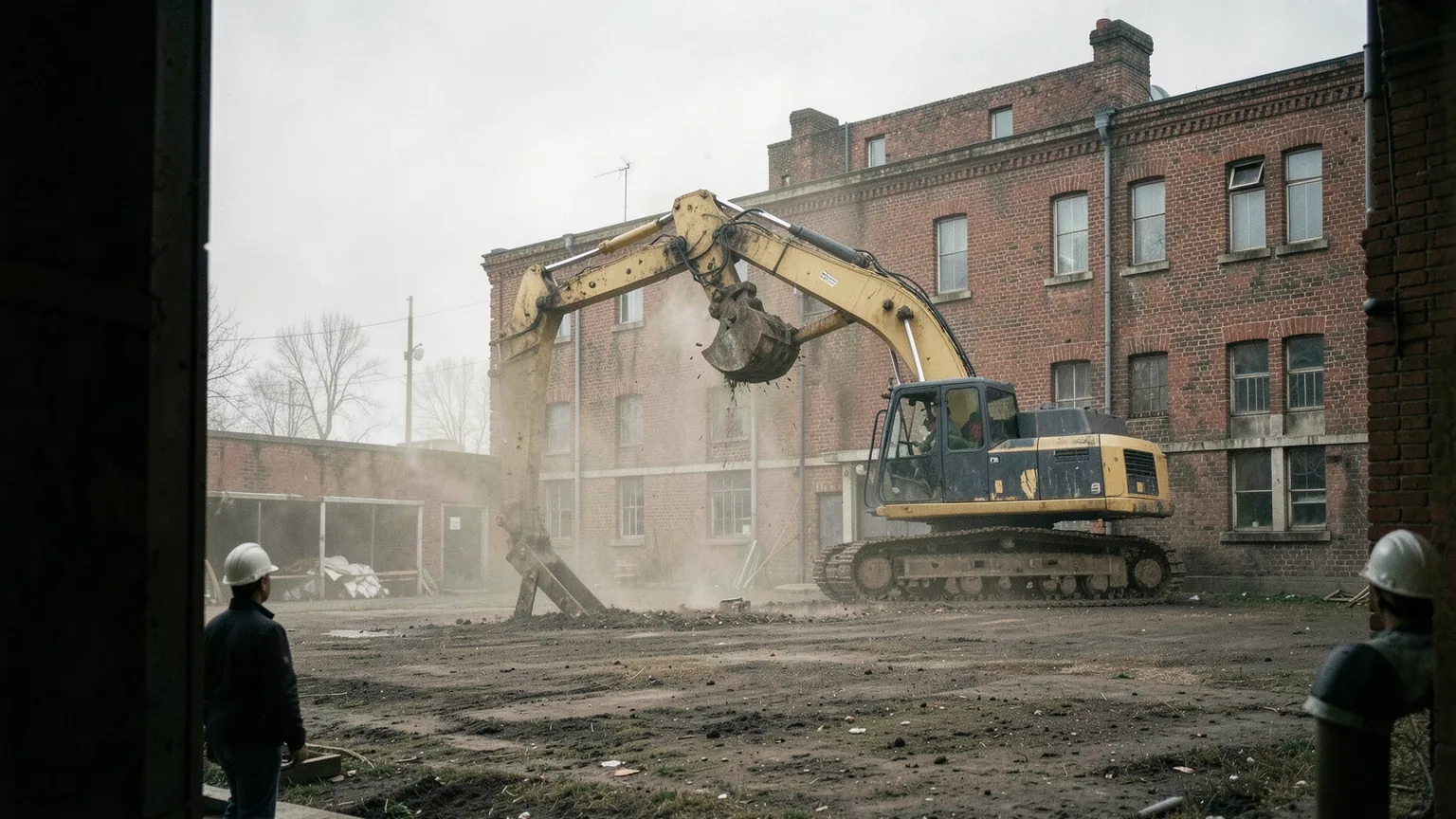
Mechanical demolition with excavators
Mechanical demolition uses excavators or similar machines fitted with breaking or shearing attachments. It is the most common method for larger buildings and for structures that can be pulled or broken down in sections. A standard excavator can reach the lower storeys, while a high-reach machine can work on upper floors without scaffolding for each level. The advantage is speed and the ability to work on sizeable structures without a large workforce on the top of the building.
The disadvantage is that machines create vibration, noise and dust, and they require space to operate. Machine demolition is therefore less suitable for a building that stands close to others, unless the adjoining structures have been surveyed and protected. The Health and Safety Executive guidance on demolition notes that the method must suit the structure and its location, and that a competent engineer may be needed for complex work or work close to a road.
Top-down and controlled reduction
Top-down demolition reduces the height of the building floor by floor, using small plant working on the floors below the work face. The Health and Safety Executive describes the method as giving greater control over the stability of the structure and over the spread of debris, because the material falls within the building's footprint rather than outwards.
The HSE guidance also explains why the method suits constrained sites. If there is little space around the structure, top-down demolition is likely to be the safest approach, and the exclusion zones can be smaller than for methods that rely on high-reach equipment. A terraced house in Bedminster or Southville, where the rear yard is narrow and neighbours are close, is a typical case where the top-down approach is worth discussing with the contractor.
Hand demolition near neighbours
Manual demolition uses hand tools, breakers and small pieces of plant to take a building down by hand. It is slower and more labour-intensive, but it produces less vibration and gives the operatives closer control over each element. Hand work is useful where the adjoining buildings are fragile, where services are unknown or where materials must be kept intact for salvage.
Hand demolition also brings its own risks. Workers spend more time close to the structure, and manual handling of debris carries a risk of injury. The method statement should say how these risks are managed and how the debris is moved from the building to the skip or lorry.
Exclusion zones and controlled collapse
Every demolition method needs a clear plan for where debris can fall. The HSE guidance requires the method to show the safe working zones, exclusion zones and debris zones for the site. The size of these zones depends on the technique, the space around the structure and the distance debris can travel. A scaffold does not allow the exclusion zone to be reduced, which surprises some owners who assume that a protective frame makes a smaller area safe.
Controlled collapse, in which a structure is brought down in a planned way, requires particular care. The guidance states that in the event of a deliberate or accidental collapse, debris must remain within the defined zone. If the consequences of a collapse could put material outside the site, a road closure may be needed to reduce the risk. Owners should expect these arrangements to appear in the method statement and in the highway permissions.
Dust, noise and working hours
Noise on construction sites is controlled by the local authority. Under section 60 of the Control of Pollution Act 1974, the council may serve a notice on the works that imposes requirements about the plant or machinery to be used, the hours in which the works may be carried out and the level of noise that may be emitted. The text of section 60 on legislation.gov.uk shows how these requirements are set, and the owner should check whether a notice applies to the job before selecting the method.
Dust control depends on the method as well. Machine work produces dust that must be damped down, and top-down working can also generate dust as floors are removed. The contractor should explain how dust will be suppressed for each method and what the neighbours can expect in terms of working hours.
Choosing between the methods
In practice most Bristol demolitions combine methods. Machines may remove the roof and upper walls, while hand work takes down the structure close to neighbouring walls and the building is reduced in a top-down sequence. The question for the owner is not which single method to choose, but whether the contractor has explained the combination clearly and given reasons for each stage.
The principal contractor is responsible for planning and managing health and safety during demolition, as the HSE guidance on principal contractors describes, so the method statement should show who makes that plan. A method statement that names a single approach without reference to the building, the neighbours or the hours of work is a warning sign. The services for commercial demolition and residential demolition show the range of work the method has to cover, and the owner can use the guidance above to ask the right questions before selecting a firm. The guide to comparing demolition quotes explains how to see whether each quote is built on the same method, and the skip and hoarding licences guide covers the highway side of the same decision. Requests can be sent through the quote request page, with the method question asked of every firm.
Questions to put to a demolition method
Before accepting any method, the owner can ask a short set of questions that test whether the contractor understands the building. Which parts of the structure will come down first, and why? Where will the exclusion zone sit, and what happens to it if the building moves during the work? How will neighbouring walls be protected and monitored? What dust control applies at each stage, and who checks it? How will noise be kept within any hours or limits the council sets?
The answers should refer to the building in front of the contractor. A reply that could apply to any terraced house in Bristol is not a method for this one. The owner should also ask what the contractor will do if the structure behaves differently from the survey, and how the change will be recorded and priced.
Finally, ask who on site decides when conditions change. The method statement may name a site supervisor, but the owner should know whether that person can stop work, change the sequence or call in an engineer. Those answers are a better guide to the quality of the job than any description of equipment.
A practical check is to ask the contractor to walk the neighbours through the sequence before the start date. Neighbours who know when the loudest work will happen, and where the dust will be controlled, tend to raise fewer concerns while the job is running. A contractor who cannot describe the sequence in plain language may not yet have planned it in enough detail.
Sources and further reading
- Demolition (HSE)
- Control of Pollution Act 1974, section 60: control of noise on construction sites (legislation.gov.uk)
- CDM 2015: principal contractors (HSE)