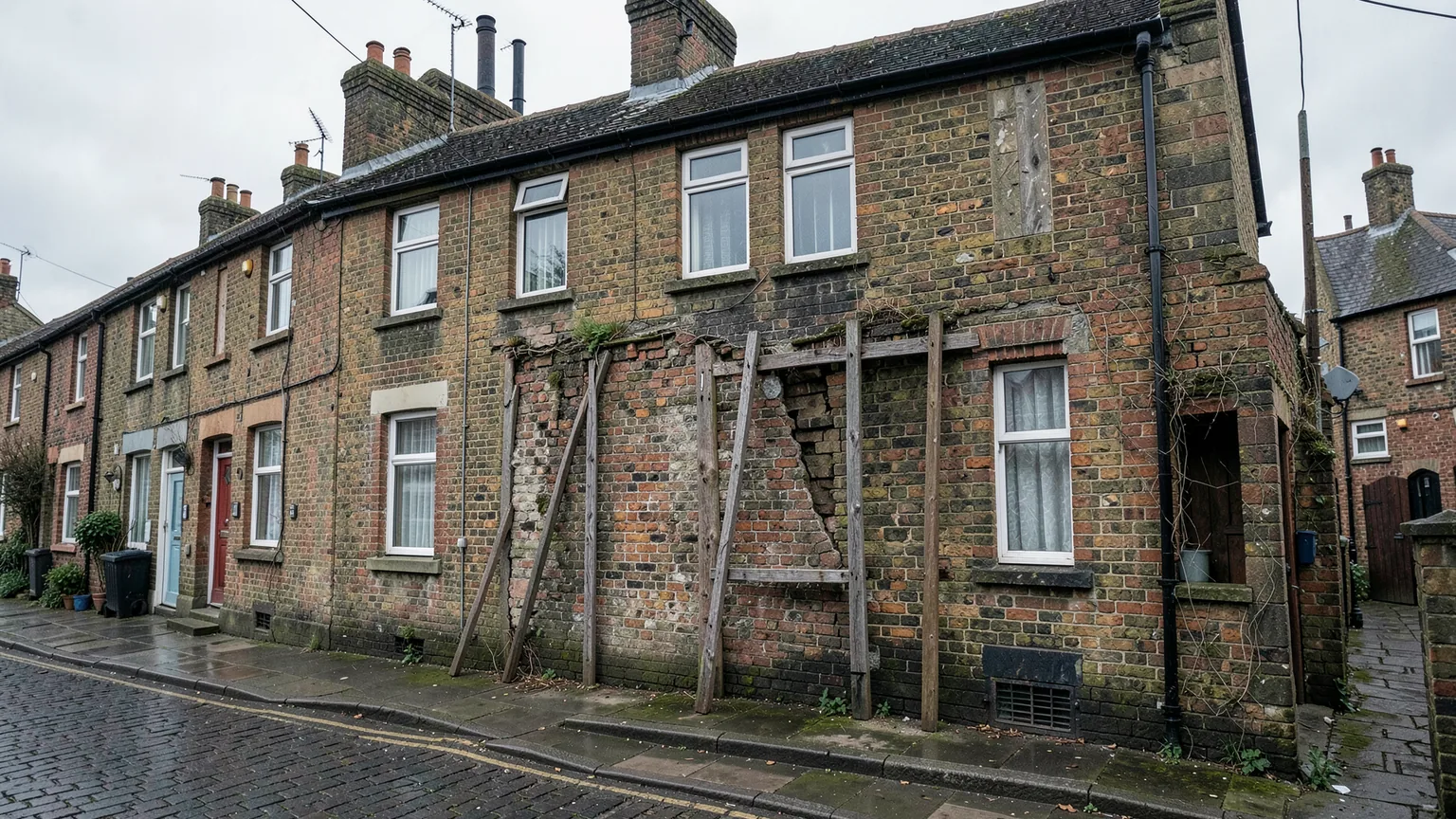
When the council orders a Bristol building made safe
A building that has been left empty, damaged by fire or weakened by years of water penetration can reach a point where the council treats it as dangerous. When that happens, the owner loses some control over timing and cost, because the council has statutory powers to order work and to recover the cost of acting. This guide explains the main powers in the Building Act 1984, what emergency action looks like in practice and the choices an owner has once a notice or order arrives.
How a building comes to the council's attention
Anyone can report a dangerous building or structure to the local council. The GOV.UK guidance on reporting a dangerous building says that a dangerous building can be reported to the local council, and the same route applies to a wall leaning over a pavement, a roof that is shedding slates or a partly collapsed outbuilding. Reports come from neighbours, passers-by, the fire service and the council's own inspectors. In Bristol the council acts as the building authority for these matters. Its dangerous structure page explains that a surveyor visits to assess the danger, that the council first tries to get the owner to remove it, that it can act under emergency powers if the owner cannot be reached, and that the cost of any work it carries out can be recovered from the owner and registered as a charge on the property.
A report does not automatically lead to action. The council first has to decide whether the building is in such a condition, or is used to carry such loads, as to be dangerous. That judgement is the trigger for the powers described below.
Section 77: an order through the courts
Section 77 of the Building Act 1984 covers the usual route. If it appears to the council that a building or part of a building is dangerous, the council may apply to the court. Where the danger comes from the building's condition, the court can order the owner to carry out the work needed to remove the danger or, if the owner chooses, to demolish the building or the dangerous part and remove the rubble; where the danger comes from overloading, it can restrict how the building is used until the necessary work is done. The text of section 77 on legislation.gov.uk sets out the options available to the court.
If the owner does not comply with the order in the time given, section 77 lets the council carry out the work itself and recover the reasonable expenses of doing so, and the owner is also liable to a fine of up to level 1 on the standard scale, currently £200. That is the point at which an owner who has ignored earlier letters usually discovers that the cost of ignoring the problem exceeds the cost of acting when it first arose.
Section 78: emergency measures
Section 78 is the route for emergencies: if the council judges that a building is dangerous and the danger needs removing straight away, it can act without first going to court. Where a building is dangerous and immediate action should be taken to remove the danger, the council may take the steps necessary for that purpose. The text of section 78 requires the council, where it is reasonably practicable, to give notice of its intention to the owner and occupier before acting.
The council may recover the expenses reasonably incurred from the owner, but section 78 also tells the court hearing a claim for those costs to ask whether the council could reasonably have used the section 77 court route instead, and if it could, the council recovers nothing. The same section limits some charges: the cost of fencing off the building or arranging for it to be watched cannot be recovered for any period after the danger has been removed by other steps. An owner who receives a bill under section 78 can therefore ask for an itemised account and check each element against the period in which the danger was actually present.
What the council may require before demolition
Where demolition is part of the answer, the council can set conditions on how it is carried out. The Health and Safety Executive guidance on demolition notes that the council may specify pre-demolition requirements to reduce risk, sometimes known as a section 81 notice. It also says that before granting permission, the council should consider whether the proposed demolition method suits the structure and its location. Where the work is complex or the site is close to a road, the council may ask a competent engineer to assess the risks.
This matters for an owner choosing between repair and demolition. A structural problem that looks like an emergency may be solvable by shoring and repair, while a building that cannot be stabilised safely may need taking down in a controlled way. The engineer's view is usually the deciding factor, so the owner should ask for a written assessment rather than relying on a verbal opinion.
Owner options: repair, shore up or demolish
When a notice arrives, the owner usually has three broad options. The first is repair, which restores the building to a safe and stable condition, often with a timetable agreed with the council. The second is shoring or temporary support, which holds the structure in place while a longer-term decision is made. The third is demolition, either partial or total, carried out under the council's conditions.
Each option has its own cost profile, and where the answer begins with a strip before any structural work, the soft strip guide explains the sequence. Repair depends on the materials and the access, shoring depends on how long the support must stay in place, and demolition depends on the method, the waste and any neighbouring structures. A contractor who can explain these trade-offs for your building, rather than offering one answer without reasons, is more useful at this stage. The residential demolition service and the commercial demolition service both cover the options where demolition is the chosen route.
Where the building contains asbestos or other hazardous material, the work has to be planned around it. Asbestos can be present in older Bristol buildings even when the structure looks sound, so the asbestos service should be considered before any intrusive work begins.
What to do on receiving a notice
Read the notice carefully and note the deadline. Check whether it is a notice of intention, an order or a demand for expenses, because the rights of appeal and the steps needed differ. Respond in writing and ask for the council's engineering report or the reasons for the decision. If access is needed for an inspection, arrange it promptly, because a refusal can make the council's next step more forceful.
Get a competent structural engineer to look at the building and provide a written view on the options. Keep the council informed of the steps being taken and of the dates on which work will start. The prior approval guide explains how the council's consent processes fit alongside any notices, which can matter when demolition is the outcome.
A dangerous building is far easier to manage when the owner responds early. Once the council has begun acting in default, the choices narrow and the costs grow. Getting an engineer's view and a costed plan together at the first letter is the most effective step an owner can take, and requesting quotes from firms with experience of dangerous structures is a sensible next step once the options are clear.
Keeping a record of the council's steps
Once a council has become involved, the owner should keep a dated record of every letter, visit, telephone call and instruction. The record should note who spoke, what was said and what the owner agreed to do. This matters because the council's power to recover expenses depends on what it did and when, and an owner who can show the timeline of the danger and the response is better placed to question an itemised bill.
Keep the engineer's reports, photographs of the building before and after any temporary works, and copies of any contracts for shoring or repair. Where a notice requires work by a certain date, record when the work started and finished and the reason for any delay. If the danger is removed by one set of works and a second set follows, the record shows whether the later work was needed.
The record also helps if the building is later sold or insured. A buyer or insurer will ask whether a council notice was served, what it required and whether it was satisfied. A tidy file answers those questions quickly and gives the owner's advisers the facts they need to decide the next step.
Sources and further reading
- Report a dangerous building or structure (GOV.UK)
- Report a dangerous structure (Bristol City Council)
- Building Act 1984, section 77: dangerous building (legislation.gov.uk)
- Building Act 1984, section 78: dangerous building, emergency measures (legislation.gov.uk)
- Demolition (HSE)