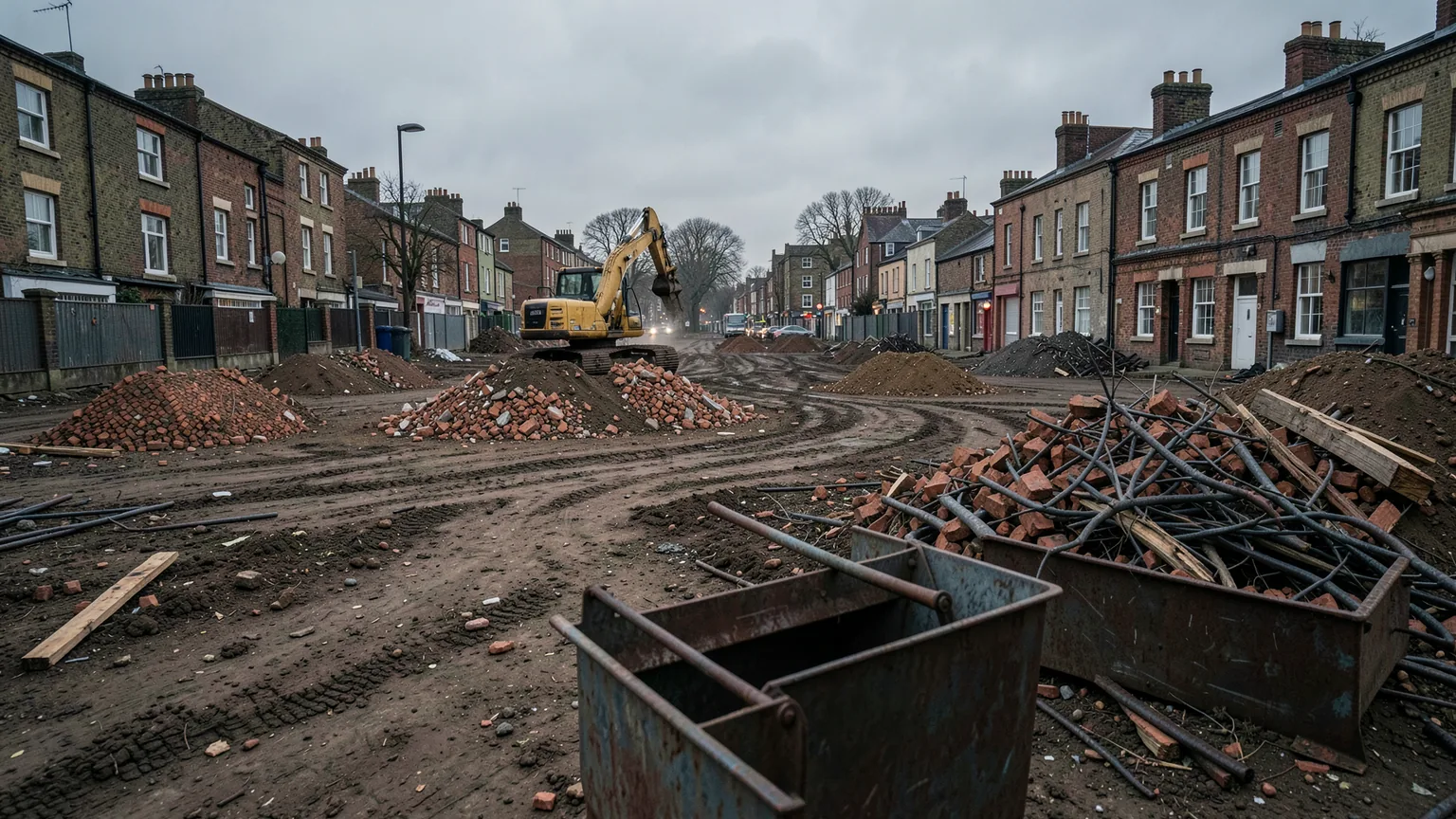
Demolition waste in Bristol: your duty of care explained
Every demolition produces waste, and the law follows that waste from the building to its final destination. In Bristol, as elsewhere in England, whoever produces or holds it has to take reasonable steps to see that it reaches a lawful destination, and that duty does not end when the lorry leaves. Handing waste to a remover who turns out to be unregistered, or who tips the load illegally, can leave the person who handed it over answerable for the consequences.
What the duty of care means
The duty of care is a legal obligation on anyone who produces, keeps, carries, treats or disposes of waste. The government's waste duty of care code of practice explains how it applies in England, and it is written for businesses and householders alike. The central idea is that responsibility does not end at the kerb or the site gate.
For a demolition project, the code treats the person whose activities create the waste as its producer, so the demolition contractor normally carries the full duty, including the transfer paperwork. A business or developer that keeps waste on its land, or deals with carriers directly, has its own duty under section 34 of the Environmental Protection Act 1990, and failing to meet it is an offence punishable by a fine. Bringing in a contractor therefore does not end a commercial client's interest in where the material goes.
Householders have a duty too
A homeowner who pulls down a garage or a rear extension personally is not exempt. The code of practice explains that the occupier of a home must take all reasonable measures to pass household waste, which here includes construction and demolition rubble, only to an authorised person, and it tells householders to look for a valid upper-tier carrier registration, which starts with CBDU. Where a contractor carries out the demolition, the same code says the waste is the contractor's responsibility and the householder's duty does not apply to it, although it does apply to anything the owner adds to the contractor's skip. Either way, checking who is taking the waste away before they take it costs nothing and shows whether the provider understands the rules.
Checking a waste carrier
Anyone who transports waste as part of a business, or who arranges for others to do it, generally has to be registered. The route to registration is described on the GOV.UK page for waste carriers, brokers and dealers, which also explains the difference between the registration tiers.
Registration is checkable. The Environment Agency maintains a public register of waste carriers and brokers, where a name or registration number can be searched in a few minutes. A reader comparing quotes can look up each provider before accepting an offer, and should do so before paying a deposit rather than after the skip has arrived.
What to look for on the register
When checking an entry, compare these details with the quote.
- The business name matches the one on the quote and the invoice.
- The registration is current and has not expired.
- The type of registration fits the work, including waste from construction and demolition.
- The registration number appears on the paperwork the provider issues.
If a provider cannot give a registration number, or the register shows nothing, treat that as a reason to look elsewhere. Informal offers to take rubble away for cash are common in any city, and they are the route by which household and building waste ends up in lay-bys and on verges.
Paperwork that proves where waste went
Registered carriers still need to document each movement. For non-hazardous waste, the standard record is a waste transfer note. The code of practice describes what it should contain: a description and classification code for the waste, the quantity, the parties involved and the date and place of transfer. Both sides must keep a copy for at least two years, and hazardous waste consignment notes are kept for three years. A householder dealing with their own household waste is not required to complete transfer notes, but a receipt naming a registered carrier is useful evidence.
The note is the evidence if a question arises later. If waste from a Bristol property is found dumped, enforcement officers can trace it back through these records. A producer who holds a complete note can show that the waste left in lawful hands, and one who holds nothing may have difficulty proving it.
Hazardous waste, including asbestos
Some demolition waste is hazardous and follows stricter rules. Asbestos-containing material is the most familiar example, and the government's guidance on disposing of hazardous waste explains the consignment process, the use of authorised carriers and the requirement to send such material to a site permitted to take it. Other items that can turn up in older buildings include some fluorescent tubes, treated timber and certain oil tanks or contaminated soil.
Hazardous waste must not be mixed with ordinary rubble. A load of brick with a few asbestos sheets thrown in becomes a far bigger problem, because the whole load may then be treated as contaminated. The asbestos survey guide explains how to find these materials before work begins, so that they can be removed separately by the right people.
Sorting waste on site
Separating materials as the building comes down is good practice for reasons of cost and recycling as well as legal ones. Clean brick, concrete, stone and hardcore can often be crushed and reused as aggregate. Timber, metals such as steel, copper and aluminium, and glass can each follow their own route.
Mixed loads are harder to process, and disposal sites generally treat them less favourably. The provider's method statement should say how materials will be separated, where they will be stored on the plot and which destinations they will go to, so that each stream can be described accurately on its transfer note.
A tidy site is also a safer one
Neat heaps by material make the work easier to supervise. They keep the access route clear, reduce the chance of someone being hurt by loose debris and let the owner see at a glance what is leaving the site. On a tight residential plot, such as a terraced yard in Bedminster or a corner plot in Fishponds, careful sequencing of skips and collections matters even more.
Records worth keeping
Keep the quote, the waste carrier's registration number, every waste transfer note, any hazardous waste consignment paperwork and photographs of the cleared plot. Store them together, because the duty of care code of practice expects records to be available if an enforcement officer or a later buyer asks for them. A buyer's solicitor may well ask about the history of a cleared site, and tidy paperwork answers the question quickly.
Reuse and recycling in practice
Older buildings in Bristol often contain bricks, slate and timber that can be recovered, and Victorian brick in particular may be worth saving intact. Salvage takes more time than machine demolition, so it affects the programme and the price. Owners who want reclaimed material should say so at the quoting stage, name which items they want to keep, and agree who owns anything removed from the site.
Fly-tipping and the risk of the lowest offer
Fly-tipping is the illegal dumping of waste, and demolition rubble is a common target because it is heavy and bulky. If a remover dumps a load, enforcement action can follow the chain of paperwork back to the producer. An owner who has no record of checking the carrier is in a weak position.
The lowest figure on a page of quotes is rarely the lowest real cost. An unregistered remover may be undercutting the market by skipping the legal disposal fee, and that saving is exactly what the owner risks paying for later through a clean-up demand or a penalty. This is why a very low figure should prompt questions rather than relief.
Who is responsible when something goes wrong
If waste is dumped, the first question an enforcement officer asks is where it came from. A registered carrier with clear paperwork is easy to trace and easy to hold to account. An anonymous van is not, which is why the burden tends to fall back on the person who commissioned the work and cannot show what was agreed.
Responsibility can also be shared. A contractor who breaks the rules can be pursued directly, while the producer may face questions about whether reasonable checks were made. Two checks, a register search and a written transfer note, are usually enough to show that care was taken. They take minutes, and they cost far less than the argument that follows an illegal dump.
What to ask for in quotes
A good quote spells out waste handling instead of burying it in a single line. Ask each provider to confirm the following and compare the answers.
| Question | Why it matters |
|---|---|
| Registration number of the waste carrier | Lets you check the public register |
| Who supplies the skips and where the waste goes | Shows the destination is lawful |
| Waste transfer notes supplied at the end | Gives you the evidence trail |
| Treatment of hazardous waste | Confirms a separate, authorised route |
| Separation for recycling | Indicates how much can be diverted from disposal |
Providers who offer site clean-up in Bristol should be able to explain this in plain terms and supply the paperwork. For the planning and notice steps that come before any waste is produced, the prior approval guide sets out the sequence.
When the details are settled, request quotes from demolition providers with the same scope and the same waste requirements stated for everyone. Quotes that answer every question above can then be compared on method and reliability as well as on the headline figure.
Sources and further reading
- Waste duty of care code of practice (GOV.UK)
- Environmental Protection Act 1990, section 34: duty of care as respects waste (legislation.gov.uk)
- Register or renew as a waste carrier, broker or dealer (England) (GOV.UK)
- Public register: waste carriers and brokers (Environment Agency)
- Dispose of hazardous waste (GOV.UK)